
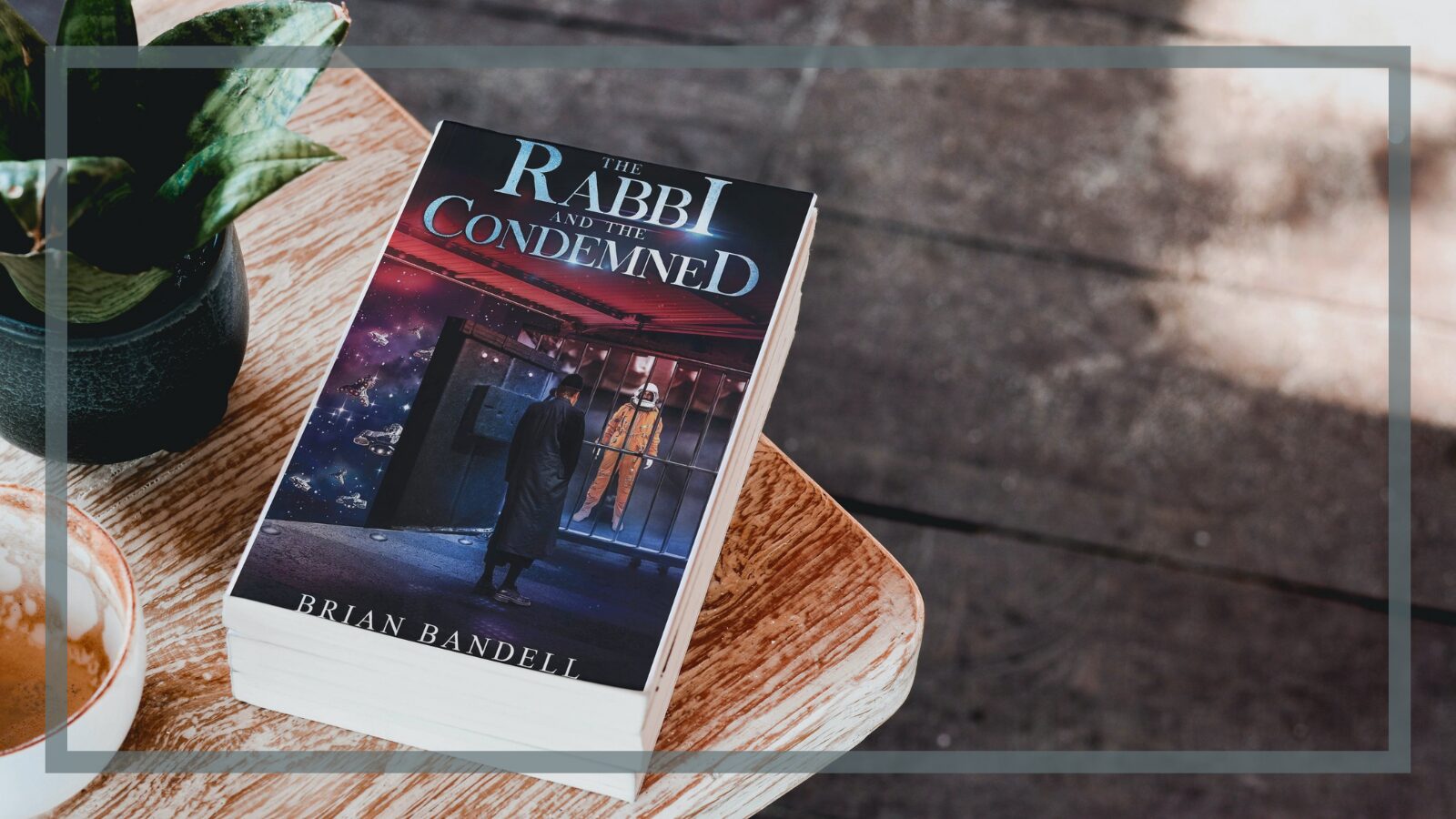
For 31 years Rabbi Samuel Rabinowitz has known Jameer Pace was innocent of murder and he has the bloody t-shirt to prove it. With his bully of a brother now dead, he finally hopes to tell the inmate in person before setting him free. But in 2053, Florida’s death row is Stark Station in the asteroid belt, where the condemned inmates are forced on deadly missions to mine radioactive rocks.
The radiation weakening him by the day, Pace doesn’t have much time left. Rabinowitz quickly realizes that achieving redemption would come at a terrible cost. Setting Pace free would have harsh repercussions for the rabbi, especially from the station’s vindictive warden. Yet, he can live no longer with the horrible secret. Upping the stakes, Rabinowitz tells a journalist that Pace is innocent and shines the spotlight on the abusive practices in Stark Station.
Recently I was asked by author Brian Bandell to review his latest book The Rabbi and the Condemned. I previously reviewed his novel Silence the Living back in 2018 and had a really great interview with Brian then too. So when I received the request, I happily obliged! I was interested in the concept of the novel and also very impressed that in four years Brian already had another book under his belt!
So without further ado, let’s get to the review!
Plot & Narration
I don’t want to give too much away here, as The Rabbi and the Condemned was only published recently on October 24 by Silver Leaf Books, and you can read the official blurb at the top of this post, but what I will say is that this novel could be a movie. And in case you’re confused by that, it’s definitely a compliment! (More on that later in the review.)
The novel follows Rabbi Samuel Rabinowitz to Stark Station way out in the asteroid belt where death row inmates are sentenced to hard labour mining radioactive rocks. The heavy radiation eventually kills them, but the idea is that this is okay (from the government’s perspective) since these inmates are on death row anyway. The rabbi is seeking to free inmate Jameer Pace, a man wrongfully convicted of murder three decades ago, by showing definitive proof of his innocence.
He also wants to ask forgiveness for not coming forward with this proof sooner.
As the novel progresses, we learn more and more about the rabbi, Jameer, and the abusive nature of Stark Station.
I won’t go into the narration too much either, since, again, I don’t want to give too much away, but suffice it to say it adds another interesting layer to the story.
Themes
Criminal Justice
One of the main themes of this novel is the idea of criminal justice and punishment. Bandell’s idea here to situate death row on a mining station in outer space is certainly intriguing and I found myself mulling this over time and again while reading the novel.
Is it right to condemn death row inmates to, well, death by radioactivity?
First you’d have to answer the question of whether or not death row is itself just. Many people disagree with capital punishment and don’t believe that any criminal, no matter their crime, should be sentenced to death. I’ll admit, this is a hard pill for me to swallow, especially when I allow myself to think of all the horrible, heinous, and vile crimes that can be, and are, committed. At the same time, though, I do believe in the rule of law and that two wrongs don’t make a right, which is essentially what capital punishment is. Is it right for us to condemn someone to death after they’ve committed a crime? Or is it better for the soul of our society to let them live (albeit in jail of course) and spare them, to rise above rather than stoop to their level?
Again, I do go back and forth on this. I’m sure if I was affected by a heinous crime, for example the murder of someone I love, I might find it very difficult not to wish capital punishment on the murderer. It’s only natural to want justice in the face of injustice. But from my comfy position here of never having experienced that thankfully, it’s easier to say that we should rise above such acts and not mete out retributive justice.
After all, an eye for an eye makes the whole world blind.
Secondly, if you do believe in capital punishment, you’d then have to ask yourself if death by radioactivity is right. I suspect that once you make the leap to the former, it’s not a far jump to the latter.
This question of whether it’s right for death row inmates to die like this comes up throughout the novel and it’s a question I appreciate Bandell asking. It’s these types of ideas and concepts that I enjoy philosophizing about in science fiction.
Forgiveness
The second main theme of The Rabbi and the Condemned is that of forgiveness. For 31 years the rabbi has known that Jameer Pace is innocent, and even had the proof, and for 31 years he was too afraid to come forward, instead letting Pace suffer slowly and terribly on Stark Station.
Can Rabinowitz expect forgiveness at all? After so many years of cowardice?
If you were Jameer, how would you feel? Again, not having been in that position myself, it’s easy to say that we should forgive each other’s mistakes and try to be more understanding, but if I were sentenced to prison for 31 years, well, I might feel a little differently.
Ultimately, Rabinowitz is not just asking Pace for forgiveness, but also God.
This point reminds me of a scene in the show The Chosen, which follows the life of Jesus Christ as he collects his disciples and begins his ministry. At one point Jesus says that it’s better to have made mistakes and then genuinely repented rather than having lived your whole life in righteousness. Indeed the Bible states, “I say unto you, that likewise joy shall be in heaven over one sinner that repenteth, more than over ninety and nine just persons, which need no repentance.”
I don’t want to say too much more about this particular theme, since it is integral to the character development of the rabbi. But as I said, it’s an interesting question about who deserves forgiveness and for what. Do we all deserve forgiveness, even the death row inmates? That’s for you to ponder.
Strengths & Weaknesses
Strengths
Aside from the interesting story setting with the novel taking place mostly on a prison in outer space, I also enjoyed the level of world building and detail that came along with that setting. When I said earlier that this novel could be a movie, that’s what I meant. I could really see many of the scenes playing out on the movie reel of my mind. It’s a premise that would work really well on film because it’s so visual and visceral. Bandell describes not just how the prison station looks but also how it smells, its atmosphere and ambiance, and how it makes the rabbi feel just being there.
One small but important detail that I thought was really interesting about life on the station was the drug patch that all inmates have on their arms when they go on a mining mission. Since they are mining radioactive rocks, their health and energy wanes rapidly and so they are fitted with these patches that can release any number of drugs into their systems to keep them going. Of course, this brings up all sorts of ethical questions about the treatment of inmates, but I thought it was an interesting, realistic detail to add from the story telling point of view:
“The pale-skinned woman’s name tag read ‘O’Connell’. Giving a thumbs up, she shifted up a dial that regulated the adrenaline levels in the two inmates’ blood through the patches locked to their arms. She selected Ritalin from a list of hundreds of drugs the patch could produce, sent the command to the electronic arm bracelet and the patch administered it directly to the blood stream. It was like a pharmacy the size of a quarter – except the patients had no idea what they were taking.”
There were also many scenes that are just dying for a film treatment!
Weaknesses
To be honest I only had one small issue with this novel, and only with one scene near the end (that I’m still back and forth about), so I won’t get into that here because having to explain it would give too much away.
Conclusion
Overall The Rabbi and the Condemned was an enjoyable, intriguing read. The setting and premise are really interesting, the pacing is good – there are enough action scenes and enough quiet scenes for a good mix and to keep the story moving forward. (Readers of this blog will know that I can’t stand glacially paced novels!) And the character of the Rabbi Samuel Rabinowitz was also a well-developed, multi-layered character, which I appreciated. Sometimes I felt more compassion for him, other times less so, and this push and pull on my thoughts and emotions as the reader kept me wanting to read more.
All in all, I am looking forward to the film adaptation. Fingers crossed it doesn’t ruin the book!